
Gajanan in Nature—A Wonderful Confluence of Vision,
Sadhana, and Creation
• The special feature of the Gajanan exhibition is that Puneet captured all these photographs in small frames, measuring only 2 to 3 inches, which were enlarged and presented at the exhibition, clearly reflecting his keen vision and technical skill.
 Lucknow, February 15, 2026: Gajanan is a beloved name of the first deity, Lord Ganesha. “Gaj” means elephant, and “anan” means face—meaning one with an elephant-like face. He is considered the first revered deity, personifying wisdom, discretion, initiation, and the remover of obstacles. Remembering him at the beginning of any task symbolizes success, auspiciousness, and auspicious energy. Gajanan is a living embodiment of simplicity, wisdom, and positive consciousness.
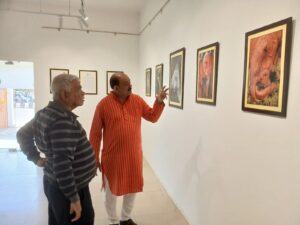
A wonderful display of 38 diverse natural forms of Gajanan, embodying this divine positive energy, took place last Sunday evening at the Kala Srot Art Gallery. The city’s talented photographer, Puneet Katyayan, presented a special exhibition, “Gajanan,” featuring 38 photographs, exploring the unique, naturally occurring forms of Gajanan on tree trunks. The exhibition was inaugurated by Padma Shri Anil Rastogi, Jai Krishna Agarwal, Anil Risal Singh, Amit Tangari, and Rajneesh Rawat. A remarkable confluence of faith, art, and nature was evident. A large number of art lovers, artists, photographers, and students enthusiastically attended the event on the auspicious occasion of Mahashivratri.
Puneet Katyayan is a Lucknow-based freelance photographer, renowned artistic photographer, and visual storyteller with over 15 years of creative experience. He received his formal art education from the College of Arts, Lucknow University, and honed his visual understanding by working as an art director in advertising agencies for nearly three decades. He currently serves as an Assistant Professor at Amity University, Lucknow, mentoring emerging photographers and visual artists.
His artistic vision focuses on the deep interconnections between nature, spirituality, and human consciousness. In Indian traditions, trees have been symbols of life and purity, but consumerism and a disregard for values have increased the exploitation of natural resources, resulting in global warming, pollution, and natural disasters that are impacting human life. Katyayan’s art is a sensitive response to this imbalance—where he finds nature’s silent warning and a hint of divinity even in cut, burned, and damaged trees.
In his acclaimed ‘Tree Bark Series,’ the embossed figures on tree bark are not merely visual structures but rather a revelation of nature’s creative power. The ‘Gajanan’ series is a spiritual extension of this vision, where various forms of Ganesha are readily visible in the tree structures. These photographs do not startle the viewer, but rather gradually penetrate within—as if a form is self-revealing in a meditative state. The absence of artificial interventions in lighting, composition, and framing bears witness to the fact that the photographer here doesn’t dictate nature, but rather bows before it, waiting. Natural colors of red, brown, and gray evoke Indian religious memory—in some places, the forehead of Ganesha appears in a vermilion glow, in others, the image of his trunk emerges from the roots. This is not merely seeing, but recognizing.
The most powerful aspect of these works is their moral and ideological dimension. The divine manifestation even in wounded trees is a profound sign—as if nature itself is saying that creation remains even amidst destruction. Katyayan’s images do not preach, but awaken consciousness through experience. Overall, the ‘Gajanan’ series emerges as a rare spiritual intervention in contemporary Indian photography, proving that if there is sensitivity in vision, even the camera can become a medium of spiritual practice—and the tree, a living temple.
In this context, senior city photographer Anil Risal said that photography has recently undergone powerful developments not only technically but also aesthetically. As a profession, hobby, and medium of creative expression, photography has documented the timeless journey of human progress through visual creativity. It is both a science involving specialized techniques and knowledge, and an art imbued with imagination, inspiration, innovation, and vision.
According to him, photography is considered the most influential invention of the nineteenth century—the most powerful visual language of communication after writing. Nature’s myriad textures, colors, and forms evoke aesthetics, and tree bark is a prime example. The images displayed in Puneet’s exhibition create a unique visual world inspired by this natural form, displaying a striking balance of wonder, imagination, innovation, and sharp visual perception.